
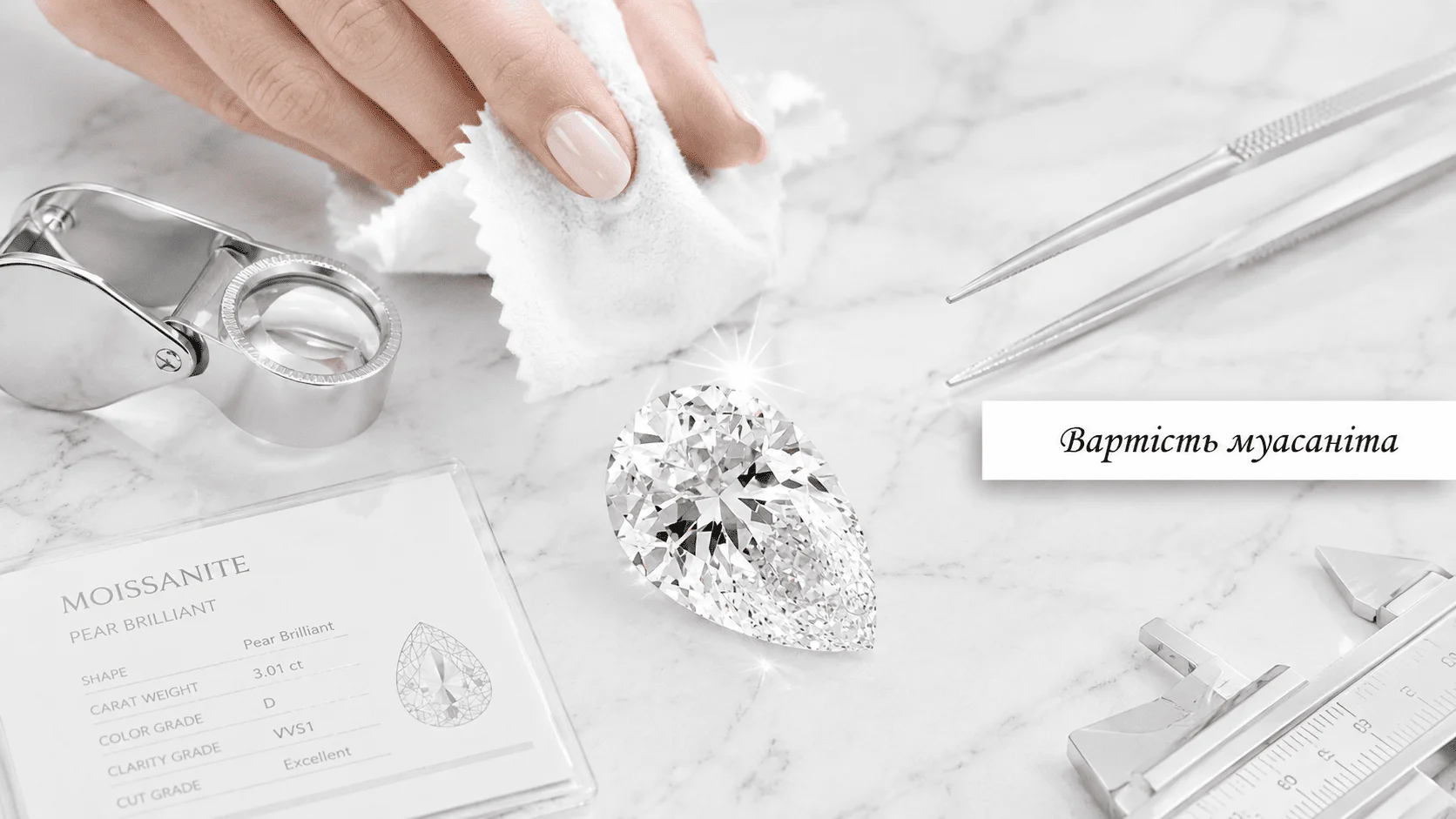
In the jewelry market, you can find moissanites at radically different prices. Visually, at first glance, they may appear similar, but when wearing the jewelry and viewing it under different lighting conditions, the differences can become obvious. Why does this happen?
Moissanite is often perceived as a uniform material, silicon carbide (SiC). Ideal moissanite is a compound consisting of one carbon atom (C) for every silicon atom (Si). However, at the atomic level, moissanites have their own “architectural” differences, known as polytypes.
A polytype is the arrangement of layers, the pattern in which the “building blocks” of carbon and silicon atoms are stacked. Simply put, it describes how Si and C atoms are arranged within the crystal lattice.
Moissanite has two main polytypes: 4H-SiC and 6H-SiC crystal structures.
4H-SiC – a modern method, 4 layers, a pure and stable crystal.
6H-SiC – a previous-generation method, a longer stacking sequence and a less stable structure.
At Moissanite Ukraine, we work exclusively with the modern 4H-SiC crystal polytype. In this article, we will explain in detail, from a scientific perspective, how different types of moissanite differ. We will explore how crystal structure affects gemstone quality and the fundamental differences between high-cost and budget crystal growth technologies.
Why is crystal structure the key to brilliance and durability?
6H-SiC Structure (Previous-Generation Technology):
This is the most common type of synthetic moissanite, dominating the market. From a technological standpoint, it is the most economically advantageous: the crystal growth process is faster, and production costs are lower.
- Color characteristics: The material has a natural tendency to display pronounced tints (yellowish, greenish, gray, or brown).
- Enhancement methods: Post-processing treatments (such as thermal or chemical treatments or the application of coatings) are used to correct the color. These conceal unwanted tones but do not change the internal crystal structure.
- Visual appearance: Although a faceted gemstone may appear relatively white to a non-expert, under certain lighting conditions, reduced transparency, “cloudiness” (caused by internal stresses in the lattice), and uneven coloration become noticeable.
Why does this happen?
6H-SiC has a heavier and less stable molecular “chain” within the mineral compound, resulting in significantly more atomic defects during crystal growth.
These defects cause unwanted tints (yellowish or greenish) and microscopic cloudiness that is difficult to eliminate even with high-quality cutting.
- Production accessibility: The 6H-SiC polytype is easier and cheaper to grow using the basic Lely method because it does not require extremely strict control over the growth environment.
- Crystal purity: Due to lower technological requirements, production becomes less controlled. Foreign impurities (nitrogen, other gases, and reagents) are present in the reactor environment, while a lack of process airtightness leads to a high percentage of crystal defects, inevitably affecting their transparency and optical clarity.
- Selection and quality: Since this is a mass-production method, its financial objective is volume. Gemstones generally do not undergo gemological quality control; only obvious defects visible without magnification are rejected. Under the guise of supposed quality control, manufacturers in this gemstone segment may sometimes provide accompanying certificates or “pseudo” gemological reports.
Caution: “Paper Certificates” and the GRA Myth
When purchasing jewelry, customers often receive accompanying plastic cards or certificates bearing the GRA (Global Gemological Research Academy) seal. It is important to understand that GRA is not an independent gemological laboratory. GRA (Global Gemological Research Academy) does not exist as an expert institution with legal authority in gemstone evaluation.
GRA is a marketing tool for a certain segment of gemstones. In such “certificates,” grades of D (the highest color grade) and Excellent (the highest cut grade) are automatically assigned to absolutely every gemstone without exception.
Why Is This Dangerous for Buyers?
- Lack of examination: The gemstone undergoes no genuine evaluation.
- Inflated expectations: When you receive a gemstone with a GRA certificate, it often does not match the stated D color grade because the 6H structure physically cannot be perfectly colorless.
- Risk of substitution: There is a high probability that a gemstone sold as moissanite with a GRA certificate may turn out to be an entirely different stone, such as cubic zirconia, since no professional gemological examination is performed in such cases.A laser inscription alone does not confirm that a gemstone is actually moissanite. Such inscriptions are also applied to other types of gemstones, including cubic zirconia.
4H-SiC Structure (Modern Technology and Premium Quality):
4H-SiC represents modern crystals used by our company, Moissanite Ukraine, and other world-class companies.
Growing pure 4H-SiC requires an advanced method with precise control of temperature (up to 2600°C) and pressure. The result is completely colorless crystals (D–E–F grades) that demonstrate perfect transparency and maximum play of light.
All moissanites in the “premium” segment are produced using the 4H-SiC crystal structure (a hexagonal lattice with 4 layers).
Color and clarity: Using the 4H-SiC polytype in combination with the PVT (Physical Vapor Transport) method minimizes the influence of foreign impurities on the crystal structure. This technology makes the material stable and “pure,” allowing completely colorless crystals with the highest color and clarity characteristics to be obtained.
Optical effects: The gemstone has no yellow or green tints and demonstrates perfect transparency, fully revealing its refractive index and light dispersion properties.
Selection and quality: The quality of each individual gemstone is checked manually by a specialist. This helps eliminate all gemstones with defects, unwanted tints, and cutting errors. Renowned manufacturers apply several stages of sorting and quality control, from production monitoring to the final gemological examination before sale.
The difference in price is determined by how precisely the technology can control the uniform atomic stacking of layers during crystal growth, without unwanted impurities or interruptions in growth cycles.
A significant portion of the production cost also comes from multi-level quality control, the work of cutting specialists, and the inspection of finished gemstones, during which specimens with undesirable characteristics are rejected.
Crystal Growth Rate
Time spent in the reactor, environmental purity, and the growth method are important components of moissanite production costs.
As mentioned above, the PVT growth process requires maintaining extreme temperatures of 2400–2600°C. This results in high electricity consumption and wear of tungsten or graphite crucibles. Therefore, mass-market manufacturers deliberately accelerate crystal growth to extract the maximum number of carats from their equipment each month. In less controlled growth processes, the following occurs:
Crystal Chaos
Atoms need time to arrange themselves into a perfect structure (especially in 4H-SiC). Forcing the temperature gradient causes layers to stack incorrectly. This creates so-called dislocations. Remember the comparison with “bricks”? Imagine building a wall but, in your haste, forgetting to lay an entire row of bricks. In crystal physics, these appear as dislocations: microscopic structural defects and a lack of carbon.
Carbon Vacancies (Carbon Deficiency)
During crystal growth, atoms must occupy their precise positions. If the technology does not provide ideal conditions (pressure, temperature, gas purity), “empty spaces” appear in the lattice where carbon atoms should be but are missing.
The result: Locally, within this microscopic zone, there is “more” silicon than carbon.
This directly affects the quality of the raw material. Gemologically, such a gemstone remains silicon carbide (SiC), but at the atomic level, its stoichiometry is disrupted (an imbalance in the atomic structure). This disturbed atomic balance is what causes reduced strength, loss of transparency, and unwanted color tints.
Microscopic Silicon Inclusions (Excess Silicon)
During growth by vapor-phase epitaxy or sublimation, silicon and carbon evaporate at different rates. Silicon is more volatile. If a manufacturer cuts costs on equipment for precise control of gas partial pressures, excess silicon vapor may accumulate in the environment.
The result: Excess silicon cannot integrate into the correct SiC lattice. It accumulates as microscopic droplets or causes the formation of so-called “micropipes”: hollow channels inside the crystal.
Visual effect: The gemstone loses its perfect transparency. It may appear “cloudy” or “milky,” or transmit light less effectively, destroying the play of its facets and brilliance.
Nitrogen Incorporation (Unwanted Color)
Residual gases, primarily nitrogen, are always present in the reactor environment. During slow, controlled growth, silicon and carbon atoms have enough time to displace nitrogen and occupy their ideal positions. During rapid growth, nitrogen becomes literally “trapped” in the crystal lattice.
The result: The gemstone cannot be made completely colorless and will always have a yellow or greenish tint.
Mixing of Polytypes
High growth rates destabilize the process. Instead of growing as uniform 4H (or at least pure 6H), the crystal begins to alternate layers chaotically, forming a “sandwich” of different structures (4H, 6H, 15R) within a single gemstone.
The result: Optical properties (light refraction) become uneven.
Critical Internal Stress
Rapidly grown raw material cools with enormous internal stress.
The result: Brittleness caused by high internal stress. Such a gemstone may crack during setting in metal or even from a light impact while being worn.
Summary:
Renowned moissanite manufacturers grow their crystals slowly (the growth rate is often only 1–2 mm per day). A single cycle may last several weeks. After growth, the raw material is carefully inspected, and defective crystals are rejected. This is followed by a two-stage gemstone cutting process, completed by manual selection and quality control.
Mass-market manufacturers often focus primarily on production volumes and speed. Accelerating production processes may increase the yield of raw material, including defective material, while predominantly machine-based cutting and insufficient quality control can affect the final result.
To create an impression of high quality, some sellers include marketing brochures with their gemstones that may mislead inexperienced buyers. For example, the grades “D” (colorless) and “Excellent” (the highest cut grade) may be assigned to all gemstones without proper verification of their characteristics.
Be careful: One of the most common documents accompanying mass-market moissanites is the so-called GRA “certificate.” It is important to understand that GRA is not a universally recognized independent gemological laboratory, and its documents should not be regarded as indisputable proof of gemstone quality.
When choosing jewelry, do not rely solely on a brand’s reputation. Pay attention to the manufacturer’s warranty obligations and the level of after-sales service it provides. A genuine certificate must be issued by an accredited gemological laboratory, a local or international gemstone and mineral evaluation organization with verified status and an actual database for verification.
The price difference between moissanites reflects the cost of creating a perfectly pure and stable growth environment. Other cost components include cutting, inspection and rejection of defective stones, and gemological quality supervision. Taking all these processes together, such manufacturers can offer long-term warranties on the gemstones they produce and on moissanite jewelry.
When you choose Moissanite Ukraine jewelry or gemstones, you invest in the perfect 4H-SiC structure. This guarantees flawless transparency, durability, and diamond-like brilliance that will remain in your jewelry for years. We take our responsibility to customers extremely seriously, which is why we use only the finest gemstones for every precious metal setting.
With love and care, Moissanite Ukraine